Your questions,
our answers
The questions we get on the phone, gathered in one place. Each answer links to the page where you can check it.
Septic tanks and micro-treatment plants
How often should a septic tank be maintained?
There are two rhythms, depending on the product you use.
- One dose per week with the activators (4, 6 or 12 months): pour one dose into the toilet bowl and flush, ideally at bedtime.
- One dose every six months with the micro-bead maintenance: the contents of the box into the toilet bowl, flush twice, and you are covered for six months.
The principle is the same in both cases: a regularly maintained tank does not smell and needs pumping out less often.
Check it on the site: The septic tank range, Looking after your septic tank
What dose for the number of people in the household?
For the activators, the weekly dose follows the size of the household:
- 1 to 4 people: 1 dose (or 1 sachet) per week;
- 5 to 8 people: 2 doses;
- more than 8 people: 3 doses.
Double the dose in case of prolonged absence or bad odours.
Check it on the site: Septic tank activator 6 months, Septic tank activator 12 months
Which format should I choose: 4, 6 or 12 months, sachets or micro-beads?
The number of months on the pack corresponds to one dose per week for a household of 1 to 4 people. A larger household will use it up faster.
- Activators: 4 months (18 sachets), 6 months (750 g), 12 months (54 sachets or 1500 g). One dose per week.
- Micro-bead maintenance: 6 months (500 g, a single dose) or 12 months (2 sachets of 200 g, one every 6 months). 1 sachet treats a tank volume of 1 to 3 m³.
Check it on the site: Compare the formats in the range, Septic tank maintenance micro-beads 12 months
My septic tank is blocked or smells bad: what should I do?
Routine maintenance is no longer enough, you need a recovery product:
- Septic tank unblocker (500 g): pour the entire contents of the box into the toilet bowl using the side spout, flush twice. It is also the product for restarting the tank after a pump-out, and for starting up a new tank on first use.
- Septic tank emergency (3 sachets): a three-step treatment, the red sachet on day 1 as a shock action against odours, the blue one on day 2 to dissolve blockages, the green one on day 7 for reactivation and maintenance.
Then go back to regular maintenance, or the problem will return.
Check it on the site: Septic tank unblocker, Septic tank emergency
Does the tank need restarting after a pump-out?
Yes. A pump-out removes the sludge, but also the bacteria that do the work. Septic tank unblocker is designed for these three moments: unblocking a clogged tank, restarting the tank after a pump-out, and starting up a new tank on first use.
Check it on the site: Septic tank unblocker
I have a micro-treatment plant, not a septic tank. Which product?
Micro-treatment plant activator (900 g). Mix the weekly dose in a glass of warm water and pour it into the sink, preferably at the end of the day. Leave overnight, and avoid running boiling water in the following hours.
Dosage (weekly): 1 to 4 people = 1 dose, over 4 people = 2 doses. In case of blockage, dilute the entire contents of the tub in a bucket of warm water and pour directly into the micro-treatment plant.
Check it on the site: Micro-treatment plant activator
Do bleach and wipes really harm a septic tank?
Yes, and it is the first thing to change. A septic tank is not a storage tank, it is a treatment plant: bacteria digest the sludge. A conventional caustic soda drain unblocker kills them in a single dose, and the following month the tank works less well.
The product pages sum it up in four precautions: avoid excessive bleach, no wipes or oils, zero solvents or corrosive products, and keep out of reach of children.
Check it on the site: Why it matters in your home, The septic tank range
Drains, odours and blockages
My sink drains slowly or not at all: which product?
It depends on the state of the drain.
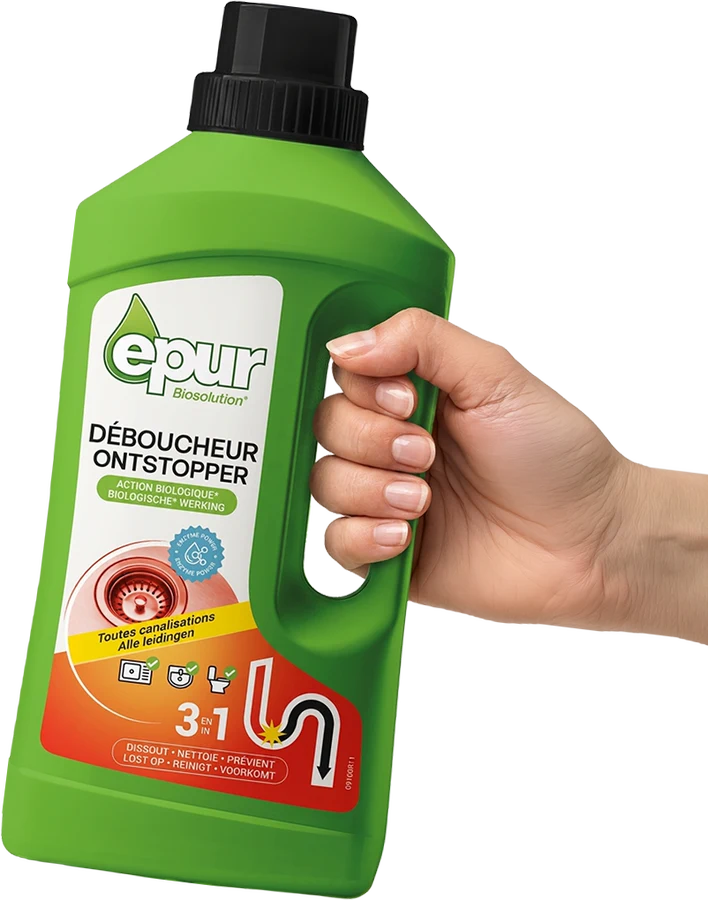
- The water still goes down, slowly: Drain unblocker (1 L, enzyme formula, free from caustic soda and acid). Pour half of the bottle (1/2 litre) down the drain, leave to act for at least 8 hours, preferably overnight, then rinse thoroughly with warm water.
- The water is standing: Caustic soda standing water drain unblocker, in gel form. Its dense gel cuts through standing water without diluting and targets the clog head-on, where a liquid would disperse. 500 ml, approx. 30 minutes, then rinse thoroughly with hot water.
Check it on the site: Drain unblocker, Caustic soda standing water drain unblocker, The pipes and drains range
It drains fine but it smells: is it a blockage?
Not necessarily. An odour without slow drainage usually comes from a greasy deposit on the pipe walls, not from a blockage. An unblocker is not the right tool here.
Drain odour stopper (1 L) deals with this: pour 250 ml into the drain on first use, then 2 capfuls (80 ml) per drain every week, and leave to act for 6+ hours without running water.
Check it on the site: Drain odour stopper, Getting rid of drain odours for good
My toilet or macerator is blocked?
Toilet & macerator unblocker (1 L) is made for this: to unblock, mix 500 ml of product with 500 ml of warm water; for prevention, mix 200 ml of product with 500 ml of warm water. Leave to act for 8 hours, then flush the toilet.
For limescale in the bowl, apply 2-in-1 Toilet descaler generously onto the bowl sides and under the rim, and leave for 20 minutes before scrubbing and flushing.
Check it on the site: Toilet & macerator unblocker, Unblocking a toilet or macerator
How can I stop it from blocking again?
Light, regular maintenance costs less than unblocking.
- Drain cleaning sticks: insert a stick into the plughole or drain grate, and running water releases the active ingredients. Repeat every month once the stick has dissolved.
- Kitchen drain maintenance or Bathroom drain maintenance: 2 capfuls per week into each drain, leave to act for 8 hours, preferably overnight.
Check it on the site: Drain cleaning sticks, Kitchen drain maintenance, Bathroom drain maintenance
Are these products safe for a septic tank?
Yes, that is what the range is for. There are two families side by side:
- The biological formulas (enzymes and non-pathogenic bacteria): free from caustic soda and acid, they actually boost the bacterial cultures in septic tanks and grease traps.
- The caustic soda unblockers (20% naturally derived caustic soda, Ecocert certified): their product pages state that they are suitable for septic tank connections under normal conditions of use.
In every case, follow the dose given on the product page, and do not mix two products.
Check it on the site: Drain unblocker, Caustic soda drain unblocker
Are there surfaces to avoid?
Yes, with acidic products. Drain odour stopper asks you to avoid contact with acid-sensitive surfaces: marble, aluminium, copper, brass, galvanised metals, enamel, and damaged surfaces.
The biological unblockers, on the other hand, are given as safe for all drains: plastic, metal, chrome. Each product page lists its own compatibilities, and that page is the reference.
Check it on the site: Drain odour stopper
Rainwater and tanks
How do I treat the water in a rainwater tank, and at what dose?
Two formats, two dosages.
- Rainwater treatment (1 kg, powder): up to 500 L, 1 dose (30 g) per 100 L of water. From 1,000 L, 5 doses per 1,000 L of water. Pour the powder directly onto the surface of the tank, preferably at the end of the day, leave overnight and wait 48 hours before using the treated water.
- Hyper-concentrated version (40 g sachets): 1 sachet for 2,000 L of water, leave to act for 24 hours before reusing the water.
In both cases, repeat every 2 months.
Check it on the site: Rainwater treatment, Hyper-concentrated rainwater treatment
Does the treated water become drinkable?
No. It is written on both product pages: this product does not make water potable. The treatment keeps the water clear and the installation clean, nothing more.
What the treated water can be used for: watering (chlorine-free), sanitary facilities, washing machine or swimming pool. It is also suitable for septic tanks.
Check it on the site: Rainwater treatment
Should I treat again after heavy rain?
Yes, heavy rain dilutes the treatment: repeat the process. On the other hand, avoid using the product right before forecast rainfall, as it would be washed away before it could work.
Check it on the site: The water treatment range
And for a grease trap?
Grease trap maintenance (750 g) is dosed like the activators: mix the weekly dose in a glass of warm water and pour into the sink at the end of the day, then leave overnight. 1 dose for 1 to 4 people, 2 doses for more. In case of blockage, dilute the entire contents of the tub in a bucket of warm water and pour immediately into the grease trap.
Check it on the site: Grease trap maintenance
Ingredients, safety, homemade recipes
Are your products harmless?
A cleaning product is still a chemical product. Our formulas are designed to be less aggressive, not harmless: follow the doses and keep bottles out of reach of children.
If a product is swallowed or splashed, call the Poison Centre on +32 70 245 245, with the packaging to hand.
Check it on the site: Our commitment
Are all your products Ecocert certified?
No, and we would rather say so. The label covers the DIY ingredients, the cleaners and the caustic soda unblockers. Other products, including the septic tank activators, fall outside the standard.
The Ecocert logo appears on the pages of the products concerned, and only on those.
Check it on the site: The awkward questions
What does ‘natural’ actually mean?
On its own, not much: the word is not regulated. What can be checked is the Ecocert detergent label, which requires a minimum percentage of ingredients of natural or mineral origin and bans a list of substances.
Trust the label, not the adjective, and that includes us.
Check it on the site: Our commitment
How do homemade recipes compare with your products?
For everyday cleaning, a recipe with baking soda and vinegar does the job very well, and we publish ours. For a blocked septic tank or a well-established clog, you need a properly dosed formulation.
We sell both: the raw ingredients and the finished products.
Check it on the site: Our tips and recipes, The DIY ingredients
Can two products be mixed?
No. The pages for the caustic soda unblockers say so explicitly: do not mix with other products. The rule applies more widely: a mixture can cancel out the effect of both, or even cause a reaction.
The classic case in homemade recipes: vinegar neutralises baking soda and washing soda. If you want both effects, use the vinegar after cleaning, separately.
Check it on the site: Caustic soda drain unblocker, Multi-surface liquid soap
My bottle does not have the same label as on the website?
That is possible: we have redesigned all our labels. All products keep the same effectiveness and reliability, and their instructions for use do not change.
Check it on the site: All our products
Buying, finding, prices
Can I order directly on this website?
No. This website is a catalogue: it has no basket, no customer account and no payment. Each product page links to the online retailers that deliver it and to the store chains that stock it.
Check it on the site: Where to find our products
Where can I find your products near me?
The ‘Where to buy’ page gives you two ways: a map where you can search by postcode or town, and the full list of stockists sorted by province, with their addresses.
The product range varies from one shop to another: call before you go if you are looking for a specific product.
Check it on the site: The map and the list of shops
Are the prices shown your prices?
No. They are taken from the retailers' websites, on a date shown under each ‘Where to buy’ block. The price shown by the retailer on the day you order is the one that applies.
Check it on the site: The product pages
I cannot find a product in the shop?
Tell us where you live and we will point you to the nearest shop that has it on the shelf: +32 69 89 07 70 or chembo-bevil@bechems.eu.
We reply to emails within two working days.
Check it on the site: Write to us
What does ‘while stocks last’ mean?
The banner appears on the pages of products that are being discontinued. They stay in the catalogue as long as retailers have stock, but will not be made again. The pages stay online so that you can still find their instructions for use.
Check it on the site: All our products
Can't find your question?
Try another word (‘odour’, ‘macerator’, ‘rainwater tank’, ‘Ecocert’), or ask us directly: we answer emails within two working days.